Etichette

Visualizzazione post con etichetta Labyrinth Lord. Mostra tutti i post

domenica 15 dicembre 2024

Il Signore dei Labirinti la traduzione italiana di Labyrinth Lord e Advanced Labyrinth Lord

Il Signore dei Labirinti

Uno dei primi retrocloni (2007) e forse il primo ad essere tradotto in italiano (2009) grazie alla meritoria opera di Tito Leati, autore qualche anno dopo, anche del bellissimo retroclone tutto italiano "L'Era di Zargo".

Il manuale presenta un gioco completo molto molto simile al gioco presentato tra il 1981 ed il 1983 dalla versione B/X di Dungeons & Dragons (mai tradotta in italiano) e dalla versione BECM (tradotta in italiano dalla Editrice Giochi), le differenze tra le due versioni e questo gioco sono davvero minime e chiunque abbia giocato alla versione italiana della Editrice Giochi si troverà immediatamente a suo agio con le regole presentate in questo volume.

La versione senza disegni è gratuita e liberamente scaricabile, ed è uno dei motivi, insieme alla fedeltà alle regole pubblicate in italia, per cui questo gioco è quello consigliato sul sito del Chimerae Hobby Group per sfruttare al meglio tutto il materiale per il D&D dell'editrice giochi e l'AD&D della Ripa (regolamento simulato con l'Edizione Avanzata di Labyrinth Lord).

Le regole

Il regolamento è, come detto, quello classico, un gioco a classi e livelli. 


I personaggi sono definiti da 6 attributi (Forza, Destrezza, Costituzione, Intelligenza, Saggezza e Carisma) che possono variare da 3 a 18 (la somma dei risultati di 3 dadi a 6 facce) per modificatori che vanno da -3 a +3 con piccole variazioni per i 6 attributi. 

Una volta determinato casualmente gli attributi i personaggi potranno scegliere la "classe" del proprio personaggio tra le 7 disponibili: Chierico*, Elfo, Guerriero*, Halfling, Ladro*, Mago* o Nano (* indica classi per i personaggi umani). Come nel gioco classico gli umani possono scegliere tra 4 classi mentre per i semiumani la classe coincide con la razza (questa regola viene modificata nell'Edizione Avanzata che vedremo nella seconda parte di quest'articolo).

Ad ogni classe sono associati dei Tiri Salvezza che consentono di evitare il peggio dei pericoli che il personaggio incontrerà nelle sue avventure.

Il combattimento è gestito in modo semplice e diretto, tutti hanno dei Punti Ferita che diminuiscono man mano che si viene colpiti a 0 PF si muore, ed è tempo di tirare per un nuovo personaggio (sempre che i compagni di avventura non si prodighino per cercare di rianimare il tapino).

La magia è di tipo memorizza, lancia e dimentica quindi la più classica magia vanciana ed è divisa tra magia per i chierici e magia per maghi ed elfi.

Il manuale ha tutte le regole che ci si aspetta, dalla gestione dell'esplorazione all'acquisto di ogni tipo di attrezzatura, dal combattimento alla magia. Tantissimi incantesimi, mostri e tesori completano il manuale.

Insomma con pochi click si dispone di un regolamento che funziona da oltre 40 anni e che ha regalato migliaia di ore di gioco e spenseriatezza a tutti quelli che hanno avuto la fortuna di giocarci.

La versione in pdf gratuita (ma senza disegni) si può scaricare direttamente da DriveThru RPG qui: https://www.drivethrurpg.com/en/product/68889/labyrinth-lord-italian-version-no-art

La versione in pdf a pagamento (completa di disegni a 4,71€) si può acquistare qui: https://www.drivethrurpg.com/en/product/68888/labyrinth-lord-italian-version


Edizione Avanzata

Chiariamo subito che il manuale dell'Edizione Avanzata non è un gioco indipendente e necessità del manuale precedente per poter essere usato (c'è da dire che qualche anno fa la Goblinoid Games ha fatto uscire un manuale Advanced Labyrinth Lord che ha unito in un unico manuale questi due manuali senza particolari integrazioni).

Ma è un manuale che trasforma il gioco da quello base appena descritto ad una versione molto prossima alla prima edizione dell'Advancend Dungeons & Dragons.

Innanzitutto vengono divise Classi e Razze, ovvero non ci sarà più la classe Elfo ma gli Elfi potranno scegliere classi diverse o addirittura "multiclassare" ovvero avanzare contemporaneamente in più classi (ad esempio un Elfo potrà scegliere di fare il Mago/Guerriero o il Mago/Ladro o il Mago/Ladro/Guerriero), le regole lasciano piena liberà al master nel decidere quali razze possono fare quali combinazioni di 2 o 3 classi, ma mette alcuni limiti (tipo non si può fare una classe razziale con un altra classe qualsiasi).

Le razze presentate sono: elfi, gnomi, halfling, mezzelfi, mezzorchetti, nani ed umani.
Le classi presentate sono: assassino, chierico, druido, guerriero, illusionista, ladro, mago, monaco (nel senso di Monaco Shaolin dedito alle arti marziali), paladino, ramingo (il ranger).

Nel resto del manuale sono presentati nuovi incantesimi, nuove opzioni, nuovi mostri e nuovi tesori.

Insomma una bella addizione che pur restando compatibile con il gioco classico espande significativamente le opzioni dei giocatori senza per questo complicare il sistema o renderlo incomprensibile per chi è abituato al gioco basico.

La versione in pdf gratuita (ma senza disegni) si può scaricare direttamente da DriveThru RPG qui: https://www.drivethrurpg.com/en/product/87957/advanced-edition-companion-labyrinth-lord-italian-no-art

La versione in pdf a pagamento (completa di disegni a 5,66€) si può acquistare qui: https://www.drivethrurpg.com/en/product/87958/advanced-edition-companion-labyrinth-lord-italian

La versione in stampa a pagamento completa dei disegni da LULU qui: https://www.lulu.com/shop/dan-proctor/labyrinth-lord-edizione-avanzata/paperback/product-1rgr572j.html

Errata

Un'altra versione dei file senza disegni sia che implementa le errata presentate nella versione avanzata del gioco che unisce le due versioni (l'Advanced Labyrinth Lord di cui parlavamo prima) si trova qui: https://github.com/Alby1987/labyrinth-lord-ita-errata


Conclusione

I due manuali, in tutte le loro versioni sono un'ottima aggiunta per chi vuole giocare vecchia scuola ed utilizzare il mare di avventure disponibili per il D&D Classico. La possibilità di avere i manuali gratuitamente e legalmente è sicuramente un'incentivo e per i più dotati artisticamente una possibilità di personalizzare il manuale negli spazi lasciati in bianco nelle edizioni gratuite.

Voglio infine nuovamente ringraziare Tito Leati per aver tradotto questi manuali e per aver creato il gioco "L'Era di Zargo" che è anch'esso straconsigliato, se ne volete sapere di più qui la mia recensione: https://d20d12.blogspot.com/2016/01/lera-di-zargo-la-recensione.html 

La pagina di LULU dove oltre ai manuali già citati troverete diverse avventure, il manuale di "L'Era di Zargo" ed un manuale del giocatore per "L'Era di Zargo" completamente gratuito che vi consentirà di farvi un'idea del gioco (che in qualche modo è una versione avanzata, rifinita, personalizzata e localizzata in base all'immaginario di un gioco classico italiano, la trovate nella vetrina di Tiptale in stampa (e non) su LULU: Labyrinth Lord e Signori di Zargo

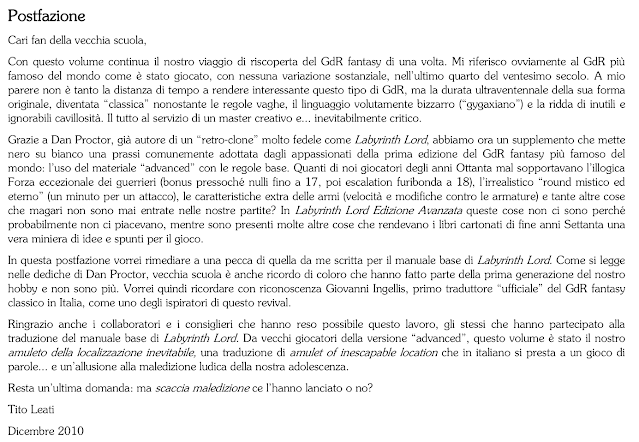
Voglio concludere lasciando la parola a Tito Leati con le sue postfazioni ai due manuali appena recensiti:

Postfazione a "Il Signore dei Labirinti"


Postfazione a "Labyrinth Lord Edizione Avanzata"


martedì 27 agosto 2024

Ducks an OSR racial class and advanced race

Castles & Chimeras will take a look at Dungeons & Ducks the first feathered rpg (that had a lot of international translations, in Italy it had a rough history changing his name a lot of times  from the first translation "Antri ed Anatre", the second one "Pertugi e Paperi" up to the final one "Pericoli e Paperi".

Ducks are a small humanoid race that migrate between prime materials plane, they usually stay in one plane for thousand of years and then most of them go to find new lands. Ducks are very versatile and they adapt and prosper in many worlds.

Ducks are a very brave race, are very good at getting along with other races and they are able to live well in almost any place.


Ducks as a playable race are found in many games, they are very famous in Glorantha (also known as Durulz) and in the swedish Drakar och Demoner  which has been translated to english as Dragonbane.

Here we present an OSR racial class for most of the OSR games (Labyrinth Lord, Basic Fantasy RPG, and so on).

DUCK
Prerequisite: DEX 9
Primary: COS
Hit Dice: 1d4
Max Level: 13th
Armors: any (but must be adapted to the small size), any shield
Weapons: any (for their small size)
Languages: Alignament, Ducktongue, Common, Draconic, Halfling*, Gnomic*

*ducks seem to have a knack for learning other small race languages 

Ducks are anthropomorphic beings covered in feathers with beaks, arms and hands and webbed feet, between 90 and 112 cm tall (88 + 2d12) but are very light for their height (30-40 kg). The plumage can have many colors but is often white or black. Ducks have four-color vision so apparently similar ducks have subtle differences in the color of their feathers that make them immediately different in the eyes of other ducks.

Combat
Ducks can use all armor and all weapons as long as they are suitable for their small size.

Hiding
Ducks are very skilled at hiding. This skill starts at 5 out of 12 at first level and improves by 1 every 3 levels (up to 9 out of 12 at 13th level)

Moving Silently (Stealth)
Ducks are very skilled at moving silently (also thanks to their feathers). This ability starts at 5 out of 12 at first level and increases by 1 every 2 levels up to a maximum of 11 out of 12 at 13th level)

Feather Fall
Ducks are very light, if not encumbered their falls are reduced by 30' and they receive half the damage for the rest of the fall. If the damage taken is greater than the remaining hp the ducks can make a saving throw vs. death if they pass it they remain with only 1 hp but unconscious for 1d6 turns.

Reading languages
Ducks in their migrations have known multiple writings. At first level they have a 7 out of 12 chance of understanding any non-magical text, this probability increases by 1 every 4 levels up to a maximum of 10 out of 12 at 13th level

Flock
If at least three ducks work together in combat they receive an offensive bonus of +2 to attack rolls and a defensive bonus of -2 to opponents' attacks, they can also decide who in the flock receives the damage (they cannot divide the damage at will but decide who in the flock will take the hit), they can do this only 2 times during a single combat, 3 times if there is at least a 7th level duck and 4 times if there is at least a 13th level duck.

Use of scrolls and magical items (use magic)
Ducks can try to use any scroll and magical items restricted to other classes, the operation is not without risks especially at the first levels. Use without problems starts from a probability of 3 out of 12 at first level and increases by 1 every 2 levels up to a maximum of 9 out of 12 at 13th level. A result of 12 means that the item or scroll does not function as it should and has dire (and often hilarious) consequences for the duck.

Duck Curiosity (Knowledge)
Ducks are very curious and gather knowledge and curiosities, they have a small chance of having some information about places, stories, magical items and monsters they encounter. This chance is equal to 1 in 12 at first level and increases by 1 every 4 levels up to a maximum of 4 in 12 at 13th level.


Advanced Options

In the advanced rules, Ducks are a race with the following characteristics

Duck
Prerequisites: minimum DEX 9
Ability Modifiers: +1 DEX, +1 CON
Languages: Alignment, Ducky, Common, Draconic, Halfling*, Gnomish*

Description and Powers: as above

Maximum Level per Class
Rogue: 13th
Fighter: 10th
Mage: 9th
Illusionist: 11th


This article is the english version of my italian article here: https://d20d12.blogspot.com/2021/05/paperi-una-razza-classe-vecchia-scuola.html
[CC BY-SA 4.0] [2024] [Fabio Milito Pagliara]


domenica 21 aprile 2019

Instant Spell Recall a spontaneous magic option for Vancian OSR systems

Art by Joyce Maureira from Scarlet Heroes free Art Pack
Instant Spell Recall I-VIII is a group of spell that let the spell-user to use an higher level spell to have the possibility to chose which spell to memorize between a small group of lesser level spell.

Instant Spell Recall I (2nd level) Conjuration/Summoning
Duration: IstantaneousCasting Time: 1+spell casting time
Saving Throw: noneArea of Effect: self
Range: selfComponents: V, S + spell components
Description: When the spell-caster cast this spell she is able to cast a single spell from a list of 5 1st level known spells (known spells are spells that were understood and wrote on the spell-user spell book), the spell-user will decide these 5 spells when he memorizes Instant Spell Recall. 

Instant Spell Recall II (3rd level) Conjuration/Summoning
Duration: IstantaneousCasting Time: 1+spell casting time
Saving Throw: noneArea of Effect: self
Range: selfComponents: V, S + spell components
Description: When the spell-caster cast this spell he is able to cast a spell from a list of 5 2nd level known spells (known spells are spells that were understood and wrote on the spell-user spell book), the spell-user will decide these 5 spells when he memorizes Instant Spell Recall.

Instant Spell Recall III (4th level) Conjuration/Summoning
Duration: IstantaneousCasting Time: 1+spell casting time
Saving Throw: noneArea of Effect: self
Range: selfComponents: V, S+ spell components
Description: When the spell-caster cast this spell she is able to cast a spell from a list of 5 3rd level known spells (known spells are spells that were understood and wrote on the spell-user spell book), the spell-user will decide these 5 spells when he memorizes Instant Spell Recall.

Instant Spell Recall IV (5th level) Conjuration/Summoning
Duration: IstantaneousCasting Time: 1+spell casting time
Saving Throw: noneArea of Effect: self
Range: selfComponents: V, S+ spell components
Description: When the spell-caster cast this spell she is able to cast a spell from a list of 5 4th level known spells (known spells are spells that were understood and wrote on the spell-user spell book), the spell-user will decide these 5 spells when he memorizes Instant Spell Recall.

Instant Spell Recall V (6th level) Conjuration/Summoning
Duration: IstantaneousCasting Time: 1+spell casting time
Saving Throw: noneArea of Effect: self
Range: selfComponents: V, S+ spell components
Description: When the spell-caster cast this spell  she is able to cast  a spell from a list of 5 5th level known spells (known spells are spells that were understood and wrote on the spell-user spell book), the spell-user will decide these 5 spells when he memorizes Instant Spell Recall.

Instant Spell Recall VI (7th level) Conjuration/Summoning
Duration: IstantaneousCasting Time: 1+spell casting time
Saving Throw: noneArea of Effect: self
Range: selfComponents: V, S+ spell components
Description: When the spell-caster cast this spell she is able to cast a spell from a list of 5 6th level known spells (known spells are spells that were understood and wrote on the spell-user spell book), the spell-user will decide these 5 spells when he memorizes Instant Spell Recall.

Instant Spell Recall VII (8th level) Conjuration/Summoning
Duration: IstantaneousCasting Time: 1+spell casting time
Saving Throw: noneArea of Effect: self
Range: selfComponents: V, S+ spell components
Description: When the spell-caster cast this spell she is able to cast a spell from a list of 5 7th level known spells (known spells are spells that were understood and wrote on the spell-user spell book), the spell-user will decide these 5 spells when he memorizes Instant Spell Recall.

Instant Spell Recall VIII (9th level) Conjuration/Summoning
Duration: IstantaneousCasting Time: 1+spell casting time
Saving Throw: noneArea of Effect: self
Range: selfComponents: V, S+ spell components
Description: When the spell-caster cast this spell she is able to cast a spell from a list of 5 8th level known spells (known spells are spells that were understood and wrote on the spell-user spell book), the spell-user will decide these 5 spells when he memorizes Instant Spell Recall.

This article present a simplified version of the Polyspell this option don't need a repertorie.

venerdì 8 marzo 2019

Human as demi-humans in OSR rule systems

Art by Andrew Krahnke
from the Spears of the Dawn free art pack
The Adventurer Conqueror King System has one of the most extensive tool set to build balanced custom class, firstly presented in the Player's Companion and then extended in books and articles (most notably in the Heroic Fantasy Companion with a lot of new classes and some magical systems and the Barbarian Conquerors of Kanahu with a lot of racial values).

The class system has also a "custom race" value that helps the creation of demi-human classes.

What we did was to create a "human custom race" in terms of the ACKS class system on one hand to recreate the already presented human classes and on the other to have ready tools for creating new human classes. We already had human with racial levels in Barbarians Conqueror of Kanahu (page 143 of the book Terran Custom Classes).

Why? Well the principal reason was to had a way to recreate the more advanced classes of Advanced Dungeons & Dragons in ACKS terms, thinking of this I had also an inspiration to add a little more fluff to this article.

The First Empire (1st E.)
The First Empire, the Empire, the Great Empire was the first to unite Human, Dwarf, Elves and others under One banner, was the first to control the eight seas and the one hundred thousand rivers. The first, and only one, to dominate the world for ten thousand years. The First Empire was truly cosmopolitan, and the various race mixed freely, after ten thousand years the humans of the empire were a little more sophisticated than the barbarian from outside the empire, an unique mix of different bloods, culture and traditions made them special. Only the First Empire Human can hope to follow the paths of the thousands of special martial and magical traditions (classes) that flourished in the First Empire.


1st E. Human Value
Value
1st E. Human
Cost*
Max Lvl
4
 Human + Thievery 4 (15 skills) 
 1500 
9
3
 Human + Thievery 3 (10 skills) 
 1000
11
2
Human + Thievery 2 (5 skills) 
 500
12
1
Human + Thievery 1 (3 skills) 
  300 
13
0
Human (Heroic Spirit)  
0
14

*NOTE: the cost of Heroic Spirit is not much (maybe 25 xp) so I decided to balance this to fudge the numbers. I'll lower the cost of  0 Value in Human so to not mess the cost of existing classes, and I will increase progressively the cost of the additional Thievery. To keep it nice I have simply calculated a cost of 100 xp per number of Thief skills.

Giving Humans a Thievery value permit the creation of a great number of custom classes since the Thief skills from the thievery value can be converted in various powers with the "custom powers trade-offs" rule

Here an example class built with this system


Art by Luigi Castellani
from the Spears of the Dawn free art pack

1st E. Human Loremaster (hd 1d4, max level 12th)
Mage 4, Human 2

Loremaster are mages specialized in knowledge and languages. They roam the world in search of knowledge both mundane and arcane and so are easily encountered in adventuring party.

The character will have all the ability and spells of the standard mage.

This character will advance to 2nd level at 3000xp, human 2 will give him thievery 2 (5 skills).

Custom Power Trade off (First Draft)
1: 1 skill at 1st level
2: 1 skill at 2nd and 1 skill at 12th
3: 1 skill at 3rd and 1 skill at 11th
4: 1 skill at 4th and 1 skill at  10th

5: 1 skill at 6th and 1 skill at 8th

1st E. Human Loremaster level progression
Experience 
Title
 Level 
 Hit Dice 
Powers
0
Scholar
 1 
1d4 Loremastery 
3'000
  
 2
2d4 Prestidigitation 
6'000
 3
3d4 Bonus Languages (+4 languages) 
12'000
  4 
4d4 Read Languages
(at will, casting time 1 turn)
24'000
5
5d4 --------
48'000
Doctor
6
6d4 Speak with Animals
(1/hour, casting time 1 turn)
100'000
7
7d4 -------
200'000
8
8d4 Speak with the Dead
(1/8hour, casting time 1 turn)
300'000
  Loremaster  
9
9d4Speak with Plants
(1/day, casting time 1 turn)  
500'000
  Loremaster of the words
10
9d4+1Command of Voice 
700'000
   Loremaster of the planes 
11
9d4+2 Contact Otherwordly Powers
(1/week, casting time 1 turn)
1'000'000
  Loremaster of the ages 
12
9d4+3 Longevity


sabato 2 marzo 2019

Health Dice a different use of Hit Dice for OSR and 5th edition

Art by Luigi Castellani
from the Spears of the Dawn free art pack
Health Dice
The basic idea behind this article is that Health Dice (HD) are fixed (10+Constitution bonus) and the type of die (d4, d6, d8) is determined by the character class.

Hit Points (HP) are, as before, just based on class and level.


In this system HP will better represent the ability to avoid fatal damage, while HD will represent the capacity of the character to recover HP.

Furthermore HD are recovered slowly and so they will represent the overall status of Health and Stamina of the character.

Number and type of Health Die (HD)
Each character will have HD equal to 10+Constitution bonus (-3 to +3) and the type of dice will be based on their class (in an OSR game we will have: Magic-Users d4, Hybrids d6, Warriors d8).
So a Fighter (d8 HD) with Constitution 13 will have 11d10 HD, a Mage (d4 HD) with Constitution 7 will have 9d4 HD.

HP recovery
As for 5th edition rules you can recover one or more (HD+Con bonus) during a "short rest" (anything from 10 minutes to one hour of rest).

HD recovery
As in 5th edition you will recover half maximum HD for each "long rest" (a full night of sleep) .

Cure Wounds
Cure spells (and  cure spell from wands, scroll and the like, potions and elixirs could make exception) should work in a slightly different manner (specially when this rules are used with the Recharging Spells rules).

Each Cure spell when used on a character will work by instantly giving the effects of a powered up "short rest", a cure spell will consume 1 HD from the receiving character that will recover (1+level of the cure spell)*(HD).

EG: a character with d8 HD will recover 2d8 from a 1st level Cure light Wounds and 5d8 from a 4th level Cure Critical Wounds, while a character with d4 HD will recover 2d4 from a 1st level spell and 5d4 from a 4th level spell.

Wounds, Fatigue, disease and other ailments
Optionally such rules can add a simple way of tracking various long term ailments of the character.

The recovery of some or all the HD can be blocked by specific conditions that can be removed by specific remedies.


Wounds
Wounds are long term damage that the character will get when he goes to 0 HP, at 0 HP a character is Knocked Out and is wounded or dead.

The severity of wounds can be rolled with various systems. The use of a Death and Dismemberment table is a good option (here an example and some link to other tables: Morte e Mutilazione).

Another very quick system could be this one: calculate the number of hp beyond zero and roll as many HD as needed to match that numbers of points, the number of needed HD represent the severity of the wound. To get back the ability to recover that HP you must first fully heal that wounds. 1HD need 1 day, 2 HD 1 week, 3 HD 1 month, 4 HD 1 season, 5 HD 1 year (heal), 6 HD permanent (regeneration), 7+ HD death.

Diseases and Poisons
A disease will block the recovery of 1 or more HD, each disease will have it's special effects.

E.G.: The red death: who gets this disease will have to do one saving vs death (or a Constitution save) each day for 15 days in a row, for each failed save he will lose one HD (zero HD means death). If the character don't die after 15 days he will recover one HD each day of full rest.

Energy Drain
Energy Drain will take away HDs (instead of levels) at 0 HD the character will die and possibly come back as an undead, such HD will be recovered only by the use of "restoration" or "wish" spells.


Designer's Notes
The idea of this rule come from the necessity to synchronize the rules for magic (presentend in the article Recharging Spells a Vancian optional system for AD&D and OSR)  with the rules for HP.

The overall guiding idea is to change the economy of innate character resources by giving more resources to low level characters and lesser resources to high level character and at the same time without changing the economy of the resources that the characters can use in a single encounter.

The net effect hoped for is to have a more homogeneous feel when playing low level characters (1-6) and high level characters (14+).


Enjoy!

sabato 30 marzo 2013

La Marca Dell'Est recensione


La Marca dell'Est è un retro-clone (ovvero un regolamento per giochi di ruolo molto simile al famoso Dungeons & Dragons pubblicato anche in Italia negli anni 80 dall'Editrice Giochi) spagnolo tradotto in italiano dai tipi della redglove (qui la sezione del loro sito dedicato a questo gioco), il regolamento è basato su quello di Labyrint Lord (il link vi porta alla versione italiana scaricabile gratuitamente su DriveThruRPG al nostro articolo sul gioco con tutti i link per scaricare la versione grautita in italiano o acquistare i libri in italiano) con una serie di modifiche e particolarità.

Ci sembra doveroso segnalare il blog degli autori del gioco (in spagnolo) Adventuras en La Marca Del Este, il profilo facebook dedicata al gioco "La Marca Del Este" ed anche il profilo G+ con lo stesso nome "La Marca Del Este" (purtroppo G+ non esiste più da anni).

Il gioco richiama fin dai colori e dalla scelta di presentarsi in scatola la famosa “scatola rossa” (proprio quella pubblicata anche in Italia) richiamo che diventa esplicito nell'introduzione fatta dagli autori.

La scatola ed i suoi contenuti
All'interno della scatola italiana troviamo un set di dadi (1xd4, 1xd6, 1xd8, 1xd10, 1xd10% – un d10 numerato 00, 10, 20 ecc, 1xd12 ed 1xd20) – confessiamo che avremmo preferito 3xd6 al posto del d10 con le decine – uno schermo del narratore di grande utilità con tabelle e dati utili durante il gioco, 50 schede del personaggio e il pezzo forte ovvero il manuale d'avventura contenente tutte le regole pieno d'illustrazioni di buona qualità, le uniche a colori sono quelle della copertina, della scatola e dello schermo del Narratore mentre l'interno è tutto in b/n; nell'edizione spagnola era presente anche una matita personalizzata con il logo del gioco qui assente ma a parte il piacere di un gadget aggiuntivo l'assenza della matita nulla toglie alla ricchezza della scatola.


Il manuale d'Avventura


Il regolamento di Labyrinth Lord è noto e gratuitamente disponibile in rete anche in italiano e quindi mi concentrerò sulle differenze tra i due regolamenti.

Rispetto ad alcuni regolamenti moderni segnaliamo che le caratteristiche sono le solite 6 (Forza, Destrezza, Costituzione, Intelligenza, Saggezza e Carisma) con i bonus vanno da -3 a +3 (per una caratteristica di 18 o 19 – qui una nota in ogni tabella c'informa che il bonus aumenta di +1 per ogni 2 punti di caratteristica), che la generazione del personaggio consigliata è tira 3d6 in ordine o 4d6 (scarta il più basso in ordine) ma che si ritirano tutti i punteggi inferiori a 6, non c'è differenza tra classe e razza (ovvero l'elfo è un mago-guerriero e basta), la Classe d'Armatura è discendente (9 è la peggiore -1 è molto difficile da colpire), che i tiri salvezza sono i classici 5 (Veleni, Bacchette Magiche, Pietrificazione o Paralisi, Attacchi con Soffi, Incantesimi e Armi Magiche) dipendenti da classe e livello, gli allineamenti sono solo 3 (Legale, Neutrale e Caotico) senza reinterpretazioni significative (il Legale è buono, eroico ed altruista; il Neutrale pensa che il fine giustifichi i mezzi; il Caotico è un pazzo psicotico). I pesi e le misure sono espressi nel sistema metrico internazionale ed i punti esperienza si guadagnano uccidendo mostri o recuperando tesori.

Vediamo ora alcuni dettagli cercando di soffermarci sulle differenze dal regolamento base o da Labyrinth Lord.


CLASSI (tra parentesi i requisiti minimi per accedere alla classe, ove non specificato la classe non ha limiti di livello e nel manuale le tabelle arrivano fino al 20' livello), elencate secondo l'ordine del manuale (probabilmente si è mantenuto l'ordine dei nomi spagnoli):
  • Chierico (SAG 10): d6 come dado vita, incantesimi fin dal 1' livello, opzionalmente nessun limite sulle armi; Scacciare non morti: tiro 2d6;
  • Elfo (INT 12, DES 13): d6 come dado vita, il classico mago-guerriero con limite massimo di livello pari a 10, capacità di vedere al buio e di notare con più facilità porte segrete e nascoste e immunità alla paralisi;
  • Nano (CON 9): d8 come dado vita, guerriero con maggior resistenza (tiri salvezza migliori) e competenza nelle costruzioni e trappole; livello massimo 12
  • Esploratore (FOR 12, DES 9, SAG 12): d8 come dado vita, un guerriero difficile da sorprendere e capace di seguire i suoi nemici, particolarmente letale contro gli umanoidi malvagi (orchetti, goblin, giganti ecc) contro cui riceve un bonus di +1 per livello (non è chiaro se il bonus è ai danni o alla possibilità di colpire; nell'AD&D era un bonus ai danni per quest'abilità del Ranger), e un compagno animale all'ottavo livello; non possono usare lo scudo;
  • Guerriero (FOR 10): d8 come dado vita, di diverso dal solito acquista un attacco aggiuntivo al 15' livello ed un altro ogni 5 livelli, fino a 4 attacchi al 25' livello;
  • Halfling (DES 9, COS 9): d6 come dado vita, limitati all'uso di armi a una mano, possono usare qualsiasi armatura e sono abilissimi a nascondersi; livello massimo 8
  • Ladro (DES 10): d4 come dado vita,
  • Mago (INT 10): d4 come dado vita,
  • Paladino (FOR 12, SAG 12, CAR 12): d8 come dado vita, un guerriero con immunità alle malattie, innata protezione dal male e capacità di percepire il male a volontà; dal 9' livello lancia incantesimi di chierico, scaccia i non morti come un chierico di 2 livelli in meno, bonus ai tiri salvezza e obbligo di donare il 20% dei tesori conquistati.

Combattimento:
  • Tiri critici e catastrofici: 20 dà il doppio dei danni, 1 un problema improvvisato dal Narratore
  • un'inspiegabile modifica a 3 metri (invece di 1,5 m) della distanza minima per utilizzare le armi a distanza (forse un errore?) che priva di senso la distanza minima di alcune armi (non esiste cioè una distanza dove applicare il bonus per la distanza minima);
  • un bonus di ben +4 per chi prende la mira per un round (rinunciando così ad attaccare o a qualsiasi altra azione) che diventa di +8 per chi usa le balestre (modifica interessante).
Tiro caratteristica:
  • Per tutte quelle prove (nuotare, correre su un pendio scivoloso ecc) non previste dalle regole si tira 1d20 cercando di fare meno della caratteristica più appropriata (scelta dal Narratore in base alla situazione) con la particolarità di utilizzare il bonus di caratteristica (cambiato di segno) come modificatore al tiro (un bonus quindi per punteggi alti) e con un modificatore per la difficoltà assegnato dal Narratore che va da -5 (compito facile) a +5 (compito difficile).
Incantesimi:
  • Il sistema magico è quello classico di D&D, ovvero lancia e dimentica;
  • Assenza di tabelle riepilogative degli incantesimi presenti nel manuale, sono gli stessi di Labyrinth Lord ordinati in modo non alfabetico (la sensazione come per le classi è che si sia lasciato l'ordine dei nomi spagnoli senza riordinarli); per gli incantesimi classici “nominali” Tenser, Nystul, Otto, Bigby ecc si sono aggiunti nuovi nomi (e.g. Il Disco Fluttuante di LL che in AD&D era Disco Fluttuante di Tenser qui diventa Disco Fluttuante di Nebulosa); particolarmente divertente la sbavatura sull'incantesimo di 9' livello “Stasi Temporale” che diventa “Estasi Temporale”....
  • Descrizioni semplici ed efficaci salvo per pochi incantesimi (Metamorfosi ad esempio)
Oggetti, Oggetti Magici e Tesori:

  • Ci sono due capitoli ragionevolmente completi uno sull'attrezzatura normale ed uno con oggetti magici e le regole per generare i tesori dei mostri.
Mostri:
  • Un ricco bestiario arricchito da un gran numero di pregiate illustrazioni in bianco e nero

Il manuale è completato da una mappa di 2 pagine (stampata nel manuale non estraibile) della Marca dell'Est, una breve descrizione della stessa di ca. 4 pagine e due avventure introduttive che occupano ben 14 pagine.


Conclusioni: il gioco è interessante e pronto all'uso, manca forse qualche consiglio su come preparare un'avventura ed altri consigli per il neofita completo, nonostante questo è un acquisto consigliato per riscoprire il gioco classico con una veste grafica rinnovata e moderna.

Aggiornamento 2 dicembre 2019: la traduzione del gioco in italiano non è purtroppo andata avanti, il gioco invece gode di ottima salute in spagna dove c'è una gran quantità di materiale ed espansioni. Può valere la pena studiare un po' di spagnolo per accedere alle tante risorse per questo gioco: https://lamarcadeleste.com/

Aggiornamento 15 agosto 2023: a maggior ragione vale la pena studiare lo spagnolo il gioco (in spagnolo) insieme a tantissime avventure è liberamente e gratuitamente scaricabile sul Codex de La marca, ecco il link all'articolo con tutte le indicazioni del caso: https://d20d12.blogspot.com/2023/08/la-marca-del-este-gratis.html.